Thursday, August 21, 2008
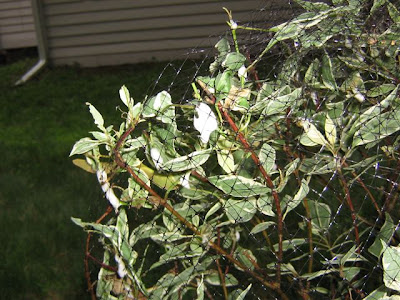
Hosta and Slug Damage
Question:
Should I remove the faded flowers from my hostas?
By August many of my hostas have tiny holes, I assume from some sort of bug or spider. I noticed this year that my new hostas in an area that in not watered as frequently are free from these "holes". Should I water less or do you have a suggestion for what to spray my plants with? It's mostly on the green/white varigated hosta.
Answer:
You can definitely remove the faded flowers from your Hosta. Removing the spent flower spike by pruning back to the foliage from where it emerged will actually be a great help to the plant as you will be redirecting water and nutrients to other parts of the plants that will be eager to make use of it.
As far as the holes, I am 95% sure it is probably slug damage. The best way to tell is actually to go out and inspect your plant late-night with a flashlight, as that is when slugs are most actively chewing away. Don’t forget to look at the undersides of the leaves as well as their tops. I know there are some granular products out there that you can sprinkle on the ground that help wipe out slug populations, but once they are adults this late in the summer I am not sure how effective those products are. I am also not sure if the granular products are very organic as I do not have any of that around to check out the ingredients. To go about a more organic control, the best plan of attack for now is physical removal. Not to mention removing as much of the pests as you can means you do not have to alter your watering schedule too much. Good, deep watering helps freshly planted plants establish healthy roots quickly in your garden so I do not want to recommend cutting back on the water if you can help it. It is gross I know, but after a couple nights you will be able to get a lot of those slugs bagged up and removed from your garden. According to The Organic Gardener’s Handbook of Natural Insect and Disease Control edited by Barbara Ellis and Fern Marshall Bradley, thin copper wire laid around the base of your plants or copper used as garden edging works to deter them, though I have never tried it. You might think I’m crazy but some friends of mine even swear by pans of beer laid underneath the plants used as traps. Either way it comes back to physical removal being one of the best options to prevent future damage of your Hosta. I hope you can get the situation under control so that the slugs do not eventually spread to your new plants. Luckily the one thing about slugs is that they are not nearly as fast moving as some other pests in the garden.
Bagworms on Bald Cypress in Brooklyn
Question:A neighbor who works with you noticed that I have bagworm cocoons on 3 of my four bald cypresses, and said that you might know what I should do about it. I took off all of them that I could reach and some had worms in them when I stepped on them. I love my trees and they have been doing well; I really don't want them to have any problems! If you have any ideas I would love to hear! Thanks a lot.
Answer:
When I was studying entomology as part of my training at NYBG I was taught that there are a number of excellent universities that provide information on various garden pests we encounter. As one example, the Ohio State University has a great series of fact sheets on various garden pests and I was able to locate one specifically on bagworms (Thyridopteryx ephemeraeformis). I have added the link, but if for some reason you want a hard copy just let me know and I can drop it in the mail to you.
Typically I see bagworms on different kinds of junipers, cedars, and arborvitae, but I guess I wouldn't be all that surprised that they are present on your bald cypresses. As you will see on the fact sheet the best thing to try and know about any garden pest is their lifecycle. That way you can then attack them when they are in their most vulnerable stage(s). Your physical control of removing them by hand is the best you can do right now. Also, it never hurts to provide the best overall care for your trees to alleviate other natural stresses. Even though we have had some serious storms we have not had many deep, soaking rains so supplemental irrigation might be a help if you can get a hose to the pits or have gator bags in place. If you can add a thin layer of mulch (only 1-2" of shredded bark or small nuggets) to the base of the trees that helps regulate soil temperature and prevent major soil temp fluctuations, especially at this hot and stressful time of year.
Hope this helps. Let me know if you need anything further.
Monday, July 7, 2008
Spittlebugs in Woodstock, NY
Hi, we planted five variegated dogwoods on our property in Ulster County last fall and after bursting to life in the Spring they now all have a white sap-like substance oozing from the leaf stems (please see attached photo) at several points.
Would you know what the problem is and how to treat it?. Over time, the leaves die and the problem moves to another part of the plant.
Answer in the form of a question:
Thanks for writing. I can’t make it out quite so easily, so let me ask you a question:
The sap-like substance, is it kind of foamy? Meaning, not very thick and viscous, but more like white foam or froth?
If so I am guessing it might spittle bugs. But let me know a little more and we will try and diagnose more concretely.
Answer to my question:
Yes it is more foamy than viscous. If you can identify we would be really grateful. The plants are at a house in Woodstock. They are the only plants affected like this.
My long-winded answer:
Thanks for the confirmation. I think it is pretty safe to say that what you have attacking your Cornus is a pest called a spittlebug. There are a number of different species of spittlebug but there is one that feeds specifically on dogwood, aptly named a dogwood spittlebug. This might also explain why they are not affecting other perennials or shrubs in the same area. Without seeing the pest myself, I must admit I am guessing, but a confident guess regardless.
Let me first give you some information about their life cycle. Inside the foamy mass of “spittle” there are spittlebug nymphs using their piercing/sucking mouthparts to feed on the delicate new growth of your shrubs. The spittle helps protect them and keep the area moist right around them so that they do not dry out. The nymphs are likely ¼” to ½” long and oval-shaped, and either yellow or yellow-green in color. (there can be some slight variation between species). If you inspect further I am guessing you will find them feeding mostly on the undersides of the new leaves where they are likely to be, again, cool and protected. Nymphs morph into adults with a similar appearance who will feed through the rest of summer and then lay white to beige eggs in rows in the leaf litter this fall.
I am glad that you have noticed them now because this is a good time to treat them. As with most pest issues, if you can find the time during the pest’s life cycle when they are in their most vulnerable form, and then attack them, you have the best chance for successful control. Even though the masses of spittle are pretty gross and overwhelming, you can rest assured that these pests are not likely to kill your Cornus shrubs. Enough damage can deform and stunt new growth, so you might have to do a little pruning late summer or early fall, but at least you don’t have to begin redesigning your garden.
As a first plan of attack I would treat your shrubs with an insecticidal soap. I should say that some believe that blasting the spittle masses with your garden hose on a strong stream is enough to disrupt, destroy and control them. However, if you are dealing with such an infestation then I am going to say let's go ahead and jump to the next step. Available at your local garden center or nursery, insecticidal soap is designed to coat and dry out and/or suffocate small garden pests that feed using their piercing/sucking mouthparts. Sold as a ready-to-use spray, coat the affected areas of your shrubs by spraying to the point of runoff. Remember that the nymphs are most likely hiding in the most protected spots, so be sure to spray the undersides of the affected leaves and stems as well. You will probably have to repeat treatment for a few weeks until you see the situation improve. Of course, read and follow the instructions on the label. Even though tedious, any physical removal of the pests and protective spittle you can do is going to be a help. If the nymphs are exposed to the hot summer sun and stressed out they should not be able to feed with the same ferocity. As a precautionary step for next year, you might choose to rake up and garbage bag the leaf litter this fall instead of leaving it or composting it. Hopefully that way any eggs that adults were able to lay will be removed before they hatch next spring.
If the combination of insecticidal soap and physical removal does not work, let me know and we can try and figure out the next serious step. I think I covered all the bases for now, but if anything is unclear, just let me know. Good luck.
A few days later, the dialog continued...
I will get the spray and saturate the plants to the point of run off this weekend and follow up with further applications. I assume "insecticidal soap" is a readily understood generic term.
One question for now, if I bag the leaves in the fall and hopefully remove any eggs, what are the odds of a new infestation in future years? Is it likely I will have to do this every year or spray early in the spring to prevent it?
And to that I replied:
Insecticidal soap should be a generic enough term and pretty easy to find at a garden center or large retailer. The most common brand name you will find is a company called Safer, so many refer to it simply as Safer Soap. Their products are excellent. I think there is also an organic one made by a company called Concern which we have used in school gardens. Either will work just fine.
There is a chance they might come back next year even though I think you have a good chance of getting the situation under control. Removing the leaf litter will be a helpful practice and then you can lay down some fresh compost or mulch in its place to protect the roots through winter. I’d hold on to the rest of the insecticidal soap as you may find a small population of them next year. But now knowing what you do, you will treat the shrubs again at the first sign of the spittle, and that should wipe out the remaining nymphs. Hopefully by two years the problem will be behind you.
Thursday, July 3, 2008
Ant Infestation!
Here's a weird problem: for the first time in the three years we lived in our 6th floor apartment we have an infestation of little black ants. Worse yet, they seem to have taken over several potted plants and turned them into "ant hills" by colonizing through the bottom of the pots.
Do you have any suggestions about how to clear them out? I will appreciate any guidance you can offer, as I know the Horticultural Society has been able to help us in the past about other matters.
Answer:
Nice to hear from you. Honestly, that ant situation is a new thing to me. I must admit, though, that I do not know as much about ants as I do other garden pests. This is what I do know:
Ants themselves do not typically do damage to or kill plants. (If they are doing damage to the roots via their tunneling, that might be another story). If ants are present, it is typically because they have found a source of honeydew to feed on. Aphids and other garden pests feed on the leaf tissue and their excrement, technically called frass, is a sweet, sticky substance called honeydew. Large quantities of honeydew on leaves can lead to a dark fungal coating called sooty mold, and can also invite ants to feed.
I would recommend inspecting your plants and seeing if you see any other signs of insects. Be sure to look on the undersides of the leaves and at the nodes, the junctions where stems and leaves meet, as these are safe places for pests to hide and feed. If you find other culprits, (aphids, mealy bugs, etc.), treat your plants with an insecticidal soap, which you should be able to find in the Flower District or at a local garden center. The insecticidal soap will not deter the ants directly, but hopefully it will wipe out any food sources that might be present and they won't be so inclined to stick around. As far as a treatment for the ants themselves, I am sorry to say I do not have a quick answer right now. We have some text here in the Library so I will review that and see what we come up with. Given this day and age I'd probably do some Google searches too and see what others recommend.
Thursday, June 5, 2008
Companion Panting in NYC Community Gardens
I am a new community gardener in New York City. I will be planting vegetables , and I wanted to know are there any companion plants I could include in my garden plot in order to keep pest(insects) away from my vegetables?
Answer:
That is an excellent question! For those of you that do not know, companion planting is a proper horticultural practice that can be a natural preventative step to fend off various pest and disease issues that can affect a vegetable garden. With the right diversity of plants and proper care you can grow a large and healthy crop without having to rely on using strong chemicals. Of course weeding and scouting for pests is still something you have to do in a garden through summer, but knowing a few reliable combinations can be really invaluable. At this moment I must admit that we do not have an updated companion planting list on hand but here at the HSNY Library we have a tremendous selection of books that would be of great assistance for your vegetable gardening efforts. In particular, Katherine Powis, HSNY Librarian, found these titles for you:
A-Z of companion planting / Pamela Allardice ; illustrations by Sue Ninham. Pymble NSW : Angus & Robertson ; New York NY : Distributed in the U.S. of America by HarperCollins Call Number: SB453.6 .A43 1993
Bob Flowerdew's complete book of companion gardening / photographs by Jacqui Hurst. London : Kyle Cathie Call Number: SB453.6 .F64 1993
Carrots love tomatoes : secrets of companion planting for successful gardening / Louise Riotte. Pownal Vt. : Storey Pub. Call Number: S603.5 .R56 1998
Companion planting : successful gardening the organic way / by Gertrud Franck : Distributed by Sterling Pub. Co. Call Number: 635 Fra
Great garden companions : a companion planting system for a beautiful, chemical-free vegetable garden / Sally Jean Cunningham. Emmaus Pa. : Rodale Press ; [New York] Call Number: SB321 .C9 1998
Planting companions / Jill Billington ; with photography by Clive Nichols. New York : Stewart Tabori & Chang. Call Number: SB453.6 .B54 1997
prepared by Katherine Powis, Librarian
The Horticultural Society of New York
148 West 37th St., 13 floor
New York, NY 10018
212 757-0915 x 109
The top two books I have used a lot and really enjoy. The others I do not know so well but I am sure they will have things to add. You are always welcome to come to the HSNY Library to read through any of these titles and discuss your vegetable garden with me if I am around. We are open 10-6 Monday through Friday and Katherine is typically here Monday through Thursday. Anyone is invited in to read and research in the library, and to borrow the books we just have to sign you up as an HSNY Member, but that takes no time. Hope this helps. Also, if you have specific pest issues or questions as the season progresses you can feel free to ask me those as well as entomology was part of my horticultural training.
