 Question:
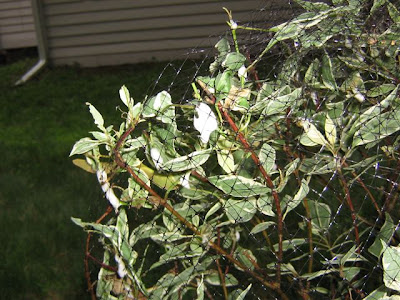
Hi, we planted five variegated dogwoods on our property in Ulster County last fall and after bursting to life in the Spring they now all have a white sap-like substance oozing from the leaf stems (please see attached photo) at several points.
Would you know what the problem is and how to treat it?. Over time, the leaves die and the problem moves to another part of the plant.
Answer in the form of a question:
Thanks for writing. I can’t make it out quite so easily, so let me ask you a question:
The sap-like substance, is it kind of foamy? Meaning, not very thick and viscous, but more like white foam or froth?
If so I am guessing it might spittle bugs. But let me know a little more and we will try and diagnose more concretely.
Answer to my question:
Yes it is more foamy than viscous. If you can identify we would be really grateful. The plants are at a house in Woodstock. They are the only plants affected like this.
My long-winded answer:
Thanks for the confirmation. I think it is pretty safe to say that what you have attacking your Cornus is a pest called a spittlebug. There are a number of different species of spittlebug but there is one that feeds specifically on dogwood, aptly named a dogwood spittlebug. This might also explain why they are not affecting other perennials or shrubs in the same area. Without seeing the pest myself, I must admit I am guessing, but a confident guess regardless.
Let me first give you some information about their life cycle. Inside the foamy mass of “spittle” there are spittlebug nymphs using their piercing/sucking mouthparts to feed on the delicate new growth of your shrubs. The spittle helps protect them and keep the area moist right around them so that they do not dry out. The nymphs are likely ¼” to ½” long and oval-shaped, and either yellow or yellow-green in color. (there can be some slight variation between species). If you inspect further I am guessing you will find them feeding mostly on the undersides of the new leaves where they are likely to be, again, cool and protected. Nymphs morph into adults with a similar appearance who will feed through the rest of summer and then lay white to beige eggs in rows in the leaf litter this fall.
I am glad that you have noticed them now because this is a good time to treat them. As with most pest issues, if you can find the time during the pest’s life cycle when they are in their most vulnerable form, and then attack them, you have the best chance for successful control. Even though the masses of spittle are pretty gross and overwhelming, you can rest assured that these pests are not likely to kill your Cornus shrubs. Enough damage can deform and stunt new growth, so you might have to do a little pruning late summer or early fall, but at least you don’t have to begin redesigning your garden.
As a first plan of attack I would treat your shrubs with an insecticidal soap. I should say that some believe that blasting the spittle masses with your garden hose on a strong stream is enough to disrupt, destroy and control them. However, if you are dealing with such an infestation then I am going to say let's go ahead and jump to the next step. Available at your local garden center or nursery, insecticidal soap is designed to coat and dry out and/or suffocate small garden pests that feed using their piercing/sucking mouthparts. Sold as a ready-to-use spray, coat the affected areas of your shrubs by spraying to the point of runoff. Remember that the nymphs are most likely hiding in the most protected spots, so be sure to spray the undersides of the affected leaves and stems as well. You will probably have to repeat treatment for a few weeks until you see the situation improve. Of course, read and follow the instructions on the label. Even though tedious, any physical removal of the pests and protective spittle you can do is going to be a help. If the nymphs are exposed to the hot summer sun and stressed out they should not be able to feed with the same ferocity. As a precautionary step for next year, you might choose to rake up and garbage bag the leaf litter this fall instead of leaving it or composting it. Hopefully that way any eggs that adults were able to lay will be removed before they hatch next spring.
If the combination of insecticidal soap and physical removal does not work, let me know and we can try and figure out the next serious step. I think I covered all the bases for now, but if anything is unclear, just let me know. Good luck.
A few days later, the dialog continued...
I will get the spray and saturate the plants to the point of run off this weekend and follow up with further applications. I assume "insecticidal soap" is a readily understood generic term.
One question for now, if I bag the leaves in the fall and hopefully remove any eggs, what are the odds of a new infestation in future years? Is it likely I will have to do this every year or spray early in the spring to prevent it?
And to that I replied:
Insecticidal soap should be a generic enough term and pretty easy to find at a garden center or large retailer. The most common brand name you will find is a company called Safer, so many refer to it simply as Safer Soap. Their products are excellent. I think there is also an organic one made by a company called Concern which we have used in school gardens. Either will work just fine.
There is a chance they might come back next year even though I think you have a good chance of getting the situation under control. Removing the leaf litter will be a helpful practice and then you can lay down some fresh compost or mulch in its place to protect the roots through winter. I’d hold on to the rest of the insecticidal soap as you may find a small population of them next year. But now knowing what you do, you will treat the shrubs again at the first sign of the spittle, and that should wipe out the remaining nymphs. Hopefully by two years the problem will be behind you.
